Access That Handles Daily Use and Weather
Roads in Dandridge for rural properties and new home construction requiring reliable vehicle access
Galloway Excavation builds private roads and residential access roads across Dandridge, designed to withstand the variable terrain and elevation changes common throughout East Tennessee. The construction process begins with excavation to remove unstable soil, followed by grading to establish proper drainage flow, then base preparation using compacted materials that resist rutting and washout. These roads serve rural properties, farms, and newly built homes where standard driveways cannot provide adequate access or turning radius for daily vehicle traffic and service deliveries.
A properly constructed access road requires more than surface gravel—it depends on subsurface stability and grade control to prevent seasonal erosion and standing water. The base layer must be thick enough to distribute vehicle weight without settling, and the crowned surface must direct runoff to the edges rather than allowing it to pool in wheel tracks. In areas with elevation change, the grade percentage affects both traction during wet conditions and the rate at which water moves across the surface.
Schedule a site evaluation to assess terrain conditions and determine the excavation depth and base requirements for your property.
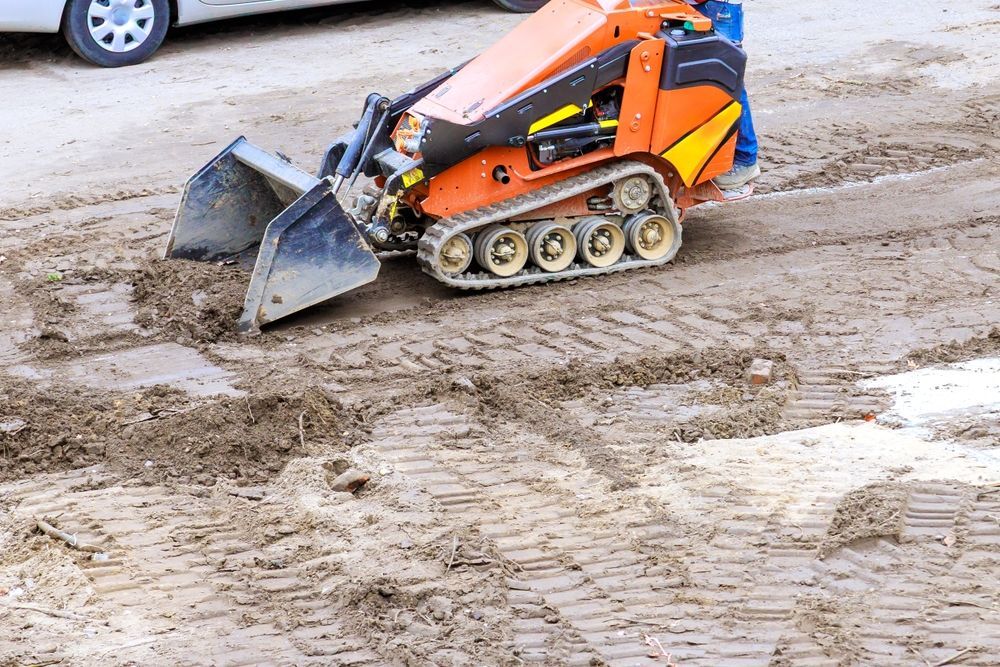
The excavation phase removes organic material and soft soil that would compress under repeated vehicle loads, creating an unstable foundation that leads to dips and uneven surfaces within the first year. Base preparation involves placing and compacting crushed stone in layers, with each layer tested for firmness before the next is added. Grading establishes the road's crown—a slight center elevation that forces water toward the edges where it disperses into vegetated areas or drainage structures.
After construction, you'll notice the road surface remains firm during rain rather than developing soft spots, and vehicles travel without bouncing or sinking into ruts. The edges stay defined instead of eroding into the surrounding soil, and the center crown continues to shed water rather than allowing it to saturate the base layer. These characteristics indicate that the base was compacted to the correct density and the grade was shaped to function as designed.
Road construction does not include culvert installation or subsurface drainage systems, though it accounts for their placement if they are installed separately. The width and turning radius are determined by the property layout and the types of vehicles that will use the road regularly, including delivery trucks and service vehicles that require more clearance than standard passenger cars.
What Property Owners Usually Ask
Questions about private road construction often relate to how the work adapts to specific property conditions and what determines long-term durability.
What determines how deep the excavation needs to go?
The depth depends on the soil type encountered during site evaluation—clay-heavy soils require deeper removal to reach stable subgrade, while rocky or dense soils may need less excavation but more grading to achieve proper slope and drainage flow.
How does elevation change affect the road layout?
Steeper grades require more careful compaction and may need switchbacks or widened sections to maintain traction during wet conditions, particularly in areas of East Tennessee where properties often include significant elevation variation between the main road and the building site.
What type of base material provides the best performance?
Crushed stone with angular edges compacts more tightly than rounded gravel, creating a base that resists shifting under vehicle weight and prevents the surface layer from sinking into the substrate over time.
When is the best time to schedule road construction?
Dry weather allows for better compaction and grading accuracy, though construction can proceed during cooler months as long as the ground is not frozen or saturated to the point where equipment cannot achieve proper soil density.
What should I expect regarding maintenance after construction?
A well-constructed road requires occasional grading to restore the crown and edge definition, particularly after heavy rain or freeze-thaw cycles, but should not need base replacement or major regrading if the initial compaction was performed correctly.
Galloway Excavation provides free estimates for private road construction, valid for three months, allowing you to plan your project timeline and budget with accurate pricing. Contact the office to arrange an on-site consultation and discuss the specific access requirements for your property.